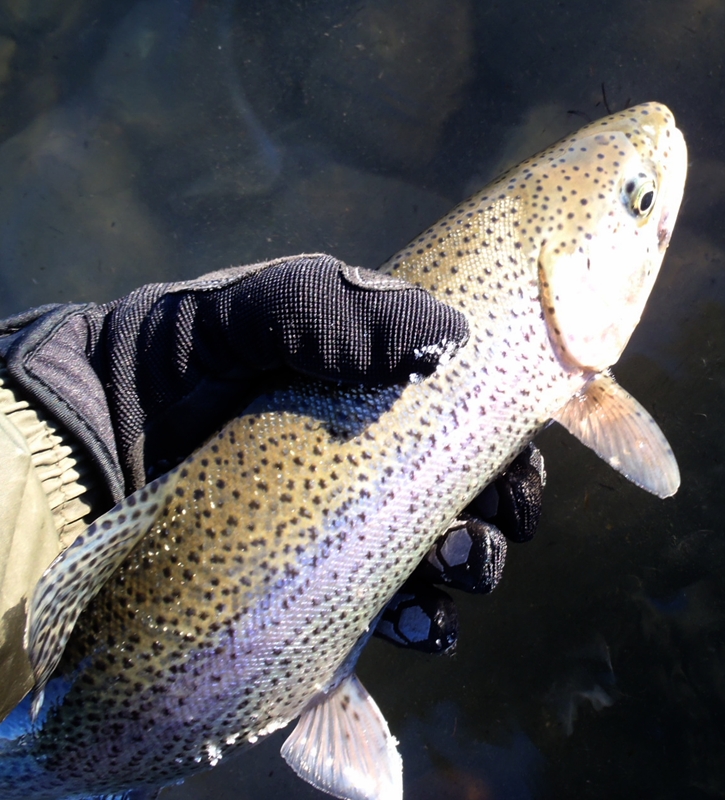
Another season underway. Spring came late to Alberta this year and I've been just as anxious to wet a line as my clients. 2011 is the first year I've offered beginner casting lessons and the response has been overwhelming with so many e-mails and phone calls. In the two weeks we've been open this season, I've managed several clients for lessons as well as the introduction to stillwater fly fishing clinics, all while still working my full time job. The wind hasn't been any help what so ever with many days of wind gusts to 100km/hr but luckily we've only had to alter the one clinic to a half day with the on the water stuff coming up on June 5th. I just hope the wind has showed the majority of it's temper for this season. If you or someone you know maybe interested in a stillwater clinic or beginner casting lessons, drop me an e-mail at mike@albertastillwaters.com.
Working with clients on their casting had really given me the itch to get out on the water and do some casting of my own. I had gotten out once this May to Salters Lake but the majority of the lake was still iced over so I'm not counting that one. My good buddy Joe (Jokey) and I headed out to Millers Lake on May 16th in hopes to get into some football shaped rainbows and maybe even hook into the odd brown that's known to be cruising around the lake. I watched the weather reports closely as once again the winds were wreaking havoc in Alberta. After some careful consideration of where we could stand a few hours of hurricane like winds with some possible shelter, we decided on Millers lake near Edson. The weather report for Edson stated; winds of 20km/hr gusting to 40 which was far better than what we could find in other areas relatively close to Edmonton. It was a pleasant surprise when we reached the lake and had to fight a stiff breeze at best. It did get a little windier later on in the day but I don't think the wind got stronger that 20km/hr the whole time we were on the lake.
Once on the water Joe headed into the shallows and picked up a few stockers while I headed straight to the drop-off at the south shoal. After some time Joe made his way over to my location and and anchored down about 40ft from me. We both hooked into a few but after about 10 mins I noticed Joe was hooking up on almost every other cast. After we realized we both were fishing the same flies, I switched over to a leach dropper with a bloodworm on the point. While I had no success, Joe continued hooking up. I then changed back to my original set up of a chironomid pupa as the dropper and leaving the blood worm on the point. I started hooking up again but nothing like what Joe had been doing. After some verbal abuse from Joe, he convinced me to move closer and start casting into his water. So I did. First cast, fish on. It appears Joe found a feeding lane right near the drop off. I should have poached his water a lot sooner. We never did hook into any browns but those little footballs fought very well. Final count, Joe 24 - Mike 13. All trout were between 14 and 18 inches.
Thursday, 19 May 2011
Sunday, 17 April 2011
Catch 22
The last seven years in Alberta or at least in north-central Alberta had see very little precipitation. Water levels were the lowest I've seen on most of our stillwater fisheries with water tables getting lower each year. The spring of 2010 saw some much needed rain that appeared to halt the lowering water tables but was really just a drop of water in the proverbial bucket. Predictions for the 2010/2011 winter were optimistic as they called for a lot of snow. The predictions were correct as a lot of snow is exactly what we got. Although we'll most likely need another three or four winters like this year to get our water levels back up to where they were, it's sure to help but comes at a price. That same snow we needed so bad to help our fisheries has also been a detriment at the same time. A catch 22 if you will. All that snow has caused winter kill issues on many of our shallower lakes with reports coming in of dead fish being seen on the bottom of these lakes. Even Muir Lake which is aerated throughout the winter months was not safe from this snowfall as oxygen levels tests in early 2011 showed low levels. The last O2 tests showed an increase in oxygen and is now out of danger, let's just hope the trout made it through those tough times.
From Alberta Sustainable Resource Development Homepage:
Edmonton... The long winter with cold temperatures and heavy snowfall may cause low oxygen levels and winter kills of fish, especially in shallow lakes. Albertans can assist the government’s monitoring of fish populations by reporting any fish kills seen on lakes after spring break-up.
Many small, shallow lakes in Alberta, whether they contain native fish or stocked trout, can suffer winter kills. Thicker ice and above average snowfall minimize light penetration, reducing aquatic plant activity, which is a source of new oxygen in winter. In shallow lakes, the combination of decomposing plants using oxygen and a long winter can also result in low oxygen levels. Larger, deeper lakes may be able to better sustain the oxygen levels necessary for fish survival over winter.
Fish and wildlife staff have been monitoring oxygen levels on selected lakes in the province. They will continue to monitor fish populations and make adjustments as necessary. Albertans are encouraged to contact Fish and Wildlife offices of Sustainable Resource Development, if they see dead fish after spring ice break-up. Phone 310-0000 (toll-free within Alberta) to contact the nearest office.
From Alberta Sustainable Resource Development Homepage:
Edmonton... The long winter with cold temperatures and heavy snowfall may cause low oxygen levels and winter kills of fish, especially in shallow lakes. Albertans can assist the government’s monitoring of fish populations by reporting any fish kills seen on lakes after spring break-up.
Many small, shallow lakes in Alberta, whether they contain native fish or stocked trout, can suffer winter kills. Thicker ice and above average snowfall minimize light penetration, reducing aquatic plant activity, which is a source of new oxygen in winter. In shallow lakes, the combination of decomposing plants using oxygen and a long winter can also result in low oxygen levels. Larger, deeper lakes may be able to better sustain the oxygen levels necessary for fish survival over winter.
Fish and wildlife staff have been monitoring oxygen levels on selected lakes in the province. They will continue to monitor fish populations and make adjustments as necessary. Albertans are encouraged to contact Fish and Wildlife offices of Sustainable Resource Development, if they see dead fish after spring ice break-up. Phone 310-0000 (toll-free within Alberta) to contact the nearest office.
Thursday, 14 April 2011
Taking One For The Team
Check out this true story of two Alberta fly guys who take one for the team and end up in court. With a little help from a F&W officer, they use the high water mark rule to win their case in court. Check out "Truth Prevailed" from the guys at For The Fly.
Friday, 1 April 2011
Floating Lines & Stillwaters
Floating lines are by far the most popular fly lines amongst steam fly anglers. They are such a versatile tool when fishing moving waters, allowing anglers to fish dry flies, streamers or nymphs. But are you aware of just how versatile these lines are when fishing stillwaters?
Crossing over from fly fishing streams to stillwaters can look intimidating. Although the techniques used for stillwaters are not exactly the same, it isn’t quite as problematic as it may appear. [read more...]
Tuesday, 1 March 2011
Introduction To Fly Fishing Seminar/Clinic
Back in November, I was approached by Camp Van-ES located just East of Sherwood Park in regards to a classroom style introduction to fly fishing clinic/seminar. Since I specialize in one-on-one stillwater clinics and have little experience teaching clinics in a classroom setting, I called up my buddy Phil who has a vasts amount of experience in these settings and we soon worked out a seminar featuring the two of us. The clinic is geared towards those brand new to fly fishing and will include basics for both stillwater fly fishing and river fly fishing. We originally had geared the clinic to 20 students and as of today have signed up 19. We are able to fit in another six students for a maximum number of 25 so if you or someone you know is thinking of getting into fly fishing or maybe you have a fly rod sitting in you garage and have always wanted to know how to use it, give Camp Van-Es a call at (780)796-3066 and take advantage of this opportunity. The following is the course outline.
Introduction To Fly Fishing Seminar/Clinic
Saturday April 2, 2011 9am-4:30pm
Presenters: Phil Rowley and Mike Monteith
Course Agenda:
9:00-9:15 Introduction and Opening including gathering class
expectations and agenda review
9:15-10:15 Fly Rods, Equipment & Casting Basics
10:15-10:30 Coffee Break
10:30-12:00 Hands on Casting Instruction
12:00-1:00 Lunch (Served on site)
1:00-2:00 Terminal Basics (Understanding leaders and essential
Knots for Fly Fishing-Hands On)
2:00-2:15 Coffee Break
2:15-3:15 Entomology 101
3:15-4:45 River Fishing 101
4:45-4:15 Lake Fishing 101
4:15-4:30 Conservation review, how to handle fish, conclusion
and wrap-up
Only 6 spaces left. All students will receive instructional booklets to keep and will learn on Sage fly rods. Clinic includes coffee, donuts and lunch.
Introduction To Fly Fishing Seminar/Clinic
Saturday April 2, 2011 9am-4:30pm
Presenters: Phil Rowley and Mike Monteith
Course Agenda:
9:00-9:15 Introduction and Opening including gathering class
expectations and agenda review
9:15-10:15 Fly Rods, Equipment & Casting Basics
10:15-10:30 Coffee Break
10:30-12:00 Hands on Casting Instruction
12:00-1:00 Lunch (Served on site)
1:00-2:00 Terminal Basics (Understanding leaders and essential
Knots for Fly Fishing-Hands On)
2:00-2:15 Coffee Break
2:15-3:15 Entomology 101
3:15-4:45 River Fishing 101
4:45-4:15 Lake Fishing 101
4:15-4:30 Conservation review, how to handle fish, conclusion
and wrap-up
Only 6 spaces left. All students will receive instructional booklets to keep and will learn on Sage fly rods. Clinic includes coffee, donuts and lunch.
Located just 15 min south-east of Sherwook Park. To Register call (780)796-3066 or email van-escamp@shaw.ca . Camp Van-Es Business Manager Bonnie Hauch.
Cost per person $75.00, cheque made payable to Camp Van-Es.
Friday, 4 February 2011
Fly Fishing Central Podcast
Friday, 21 January 2011
Traditional Sink Lines
The traditional sink line, also known as a standard sink line, forms a belly in the line as it sinks leaving the thinner tip section of line higher up in the water column. These older style lines have, for the most part, been replaced with uniform lines but can still be found and still perform extremely well in certain situations. I have to admit, when I reach for a sinking line, I’ll put on a uniform line 90% of time but there are still situations when the traditional sink line is exactly what is needed. [read more...]
Wednesday, 12 January 2011
Stillwater Retrieves
The retrieve when fishing stillwaters should, for the most part, imitate the natural movement of the flies you’re fishing. Making your flies behave in a life-like manner is an important aspect of fly fishing and even though you may find at times a retrieve that in no way mimics the naturals seen in the water may induce a strike, concentrating your efforts to closely resemble the speed and swimming motion of the naturals [read more...]
Monday, 3 January 2011
Gettin' Our Fix
| Photo by Joe Belehorec |
Here's another article I wrote for Fly Fishing Central about hanging flies under indicators.
When stillwater fly fishing, hanging chironomid patterns under an indicator is one of the most popular if not highly preferred methods of fishing a midge. This technique works whether fishing the larval or pupa stag of the chironomid although the pupa gets far more attention because of it’s slow assent to the surface and availability throughout the water column. For fisheries that allow using two or more flies, your options open up which can lead to improved success. When searching for the strike zone, a multi-fly system can both speed up your search by targeting different depths on the same rig and using various colors of patterns can more quickly determine color preference by selective trout. Another window that opens up [read more...]
Saturday, 18 December 2010
It's Christmas Time
How the time has flown this year. Feels like it was just yesterday I was enjoying the warm sun, relaxing in my 'toon and fighting big rainbows on one of my favorite stillwater fisheries. As I look outside today, with the white blanket of snow covering the streets and lawns, it makes me wonder where all the time has gone. How quickly the years seem to pass the older I get. When I was a child, the two month summer holiday I so looked forward to every year would last forever but now summer disappears in the blink of an eye. I guess the older I get the more I contemplate stuff like this as well. Anyway, here's hoping that you and your family have a chance to spend some time together and make some wonderful Christmas memories. Let's hope time slows down enough that you can actually enjoy this time of year (and then speed up afterwards so we can get back out on the water). Merry Christmas my friends and I hope it's filled with lots of Christmas magic.
Friday, 3 December 2010
Troll-Casting
I don't fish nearly as much from a float tube as I do from my pontoon boat any more. And when in my 'toon, I usually anchor down and work an area pretty hard before I move on. There are days though when I feel a need to take the float tube out, dust it off and give my legs a bit of a work out. It's times like this that I go back to what I call 'troll-casting'. Troll-casting is simply a stillwater technique which combines casting and trolling, a term I came up with to describe my actions to students interested in learning stillwater fly fishing from a float tube... [more]
Sunday, 21 November 2010
The Midge Larva (Bloodworm)
Also known as chironomids, (from the word chironomidae, meaning non-biting midge) there are many anglers who believe the two flies are different but they are indeed one and the same. As fly fishers, when we speak of the chironomid, we are usually referring to the pupa stag of the midge which is more than likely what causes this confusion. To add to this misconception, we have yet another name for the midge when in it‘s larva stag. Commonly known as a bloodworm, the midge larva is not a true worm due to it’s... (read more on Fly Fishing Central)
Labels:
bloodworm,
fishing,
fly,
larva,
larvae,
midge,
pattern,
stillwater,
techniques
Monday, 8 November 2010
Finding The Strike Zone
Getting your flies into the strike zone is fairly important when it comes to stillwater fly fishing. Just a couple of feet can mean the difference between a good day, a great day and a day when you tell your friends, "it was nice just being out on the water". Finding the strike zone starts with techniques you use up on the surface of the water and ends with your flies at just the right depth below. But just how do you find the right depth? Let's start with maps. Bathymetric … [Read more at 'Fly Fishing Central]
Monday, 1 November 2010
Got Pike?
Some fly anglers are reluctant to target pike on a fly rod. Maybe fishing for pike doesn't meet their definition of what fly fishing is all about or maybe it's because of their days spent targeting pike before picking up a fly rod. Whatever the reason, they have no idea how much fun they're missing out on. Fly fishing for pike doesn't have much finesse associated with it, chucking big streamers … Read more on Got Pike at Fly Fishing Central.
Monday, 25 October 2010
Fly Fishing Central
Last week, myself and a select group of experienced fly anglers went live with a brand new fly fishing website entitled 'Fly Fishing Central'. The concept of our website is to offer fresh new content updated weekly on all things fly fishing with articles, tips and tricks, step-by-step tying and much more. The site also features a new online forum that's already starting to see some pretty decent traffic. Fly Fishing Central is targeting a global audience and will be looking for salt water and warm water specialist in the near future. So whether you like fishing cutthroats on a stream, fat stillwater rainbows, monster pike, powerful blue fin tuna, acrobatic bass or tropical bone fish, you'll find something that peaks your interest there. Come on by, take a look around, sign up on the forum then put your feet up and set a spell. Fly Fishing Central.
To view my fist stillwater article on FFC entitled Working An Area and Observation, click here.
Sunday, 17 October 2010
Pike Time
With the weather and the waters cooling plus the days getting shorter and the boatman / backswimmer action slowing down around these parts, that usually means pike time for me. The pike will be moving into the shallows so now is the time I start looking at trips out to Wabamun for some monster water wolves. Things have changed at Wabamun however with the closing of the power plant. There won't be any more warm water coming into the lake but how this will effect the fishing has yet to be seen. Wading the mouth of the outlet will be a lot colder on the feet for sure but I'm curious if the pike will congregate to this area in the numbers we're used to seeing. You would think that they would make their way to the channel just out of habit but if the food sources aren't there like in the past they may get wise and move on. Of course this area can't be any worse than any other shallow area of Wabamun so I would assume success can be found. The question is just how successful will one be? Are the cold days of the past with pike after pike on the end of your line over or will their instinct bring them into the area with the numbers we've gotten used to? Only time and the willingness to investigate can answer that I guess. We'll see how it goes over the next few weeks.
On Saturday I took a client out for a stillwater clinic to Muir Lake. Although he did catch one nice 18 incher under an indicator on a sparkle leech, we didn't see any trout even bump the boatman or backswimmers he was fishing. The surface action was almost non-existent and the bite never did really pick up near sunset like it usually does. I'm almost certain the trout were tight to the bank, but thought it was more important to continue my clients casting into more open water than to have him constantly hooking up on weeds. Unfortunately I can't upload any pics to my pc as my daughter seems to have misplaced the CDROM that came with my new camera. Hope I find it soon.
Friday, 8 October 2010
Protection Of The Lakeshore Within The Town Of Wabamun
After 54 years of operation, this last March saw TransAlta shut down its last remaining generating unit. Their plan for next few years will be the demolition of the power plant and complete remediation and reclamation of the plant area including the wetland areas that were altered in the building of the plant back in 1956. TransAlta had built both a cold water intake channel from the lake to cool down it's generators and a warm water discharge channel to force the heated water back into the lake. Although, this reclamation would temporarily alter nesting grounds and spawning habitat, it would soon be wildlife friendly with birds and fish returning to this valuable area. Sounds pretty good heh? Well, it does until you hear what the town of Wabamun wants to do with it after TransAlta is done.
The town council is asking the Alberta Government for approval for development south of the CN rail-tracks. This area is currently where the warm water discharge channel sits and is an important nesting area for birds and spawning fish. The wetlands has no strong foundation for development meaning this marshy area would need excessive gravel fill to make it suitable to build on. According to the plans that are availble here (Discovery Wharf) the intake and outflow channels would be left behind and altered with shops, restaurants, homes, a wharf, etc, being built on the edge of them. All of the shoreline east of the channels would be filled in and developed north to the train tracks for housing, shops and a beach. These are huge nesting areas and massive spawning habitat to be lost. If you want to help at the very least, sign the petition here. http://www.gopetition.com/petitions/protection-of-the-lakeshore-within-in-the-town-of-wabamun.html.
To view this area, check out this video. The beginning of the video is the current boat launch and dock and that's where they want to build the new marina. The remainder of the video is exactly where they want the development to take place of the new wharf, all the land as far north as the plant you see and east back to the current dock would then be lost to development.
Saturday, 2 October 2010
Website Updates
2010 has been AlbertaStillwaters.Com's busiest season yet. This fall has seen many people become a part of the Alberta fly fishers fraternity through my one-on-one fly fishing clinics and the reviews have been overwhelming. Even with that though, we didn't have any clients booked for this weekend so I thought we should concentrate our efforts on some much needed website updates. As you can see on the right hand side of my blog, we now have an advertising section for sponsors of our web sites. If you're interested in advertising with us, we'll give you exposure from our three main sites (AlbertaStillwaters, Doc's Blog & Fly Fishing Edmonton) all for the price of what one site would cost you. As well, when available, we'll be removing the current ads off the Alberta Fly Fishing Forum and adding our own ads giving you another avenue to reach thousands more fly anglers.
The updates to the Fly Fishing Edmonton site consist of adding google map to all the listed lakes making finding a local fishery even easier. As well we've added Millers Lake to the list which we've been meaning to do for quite some time.
Also recently added to AlbertaStillwaters.Com, a new page featuring beginner fly casting lessons. Starting in 2011, we'll now be offering hourly casting lessons starting at $50.00 per hour available to kids 10 years of age and up and adults of any age.
If there is something you would like to see on one of our websites feel free to drop me an email at mike@albertastillwaters.com. I'll give consideration to all requests.
The updates to the Fly Fishing Edmonton site consist of adding google map to all the listed lakes making finding a local fishery even easier. As well we've added Millers Lake to the list which we've been meaning to do for quite some time.
Also recently added to AlbertaStillwaters.Com, a new page featuring beginner fly casting lessons. Starting in 2011, we'll now be offering hourly casting lessons starting at $50.00 per hour available to kids 10 years of age and up and adults of any age.
If there is something you would like to see on one of our websites feel free to drop me an email at mike@albertastillwaters.com. I'll give consideration to all requests.
Tuesday, 7 September 2010
A Backswimmer Bash
In my last post, I embedded some videos to help you get your boatman and backswimmers tied up. I've been tying myself lately and thought I would try a few out at Muir Lake on Monday. I got out on the lake in the late afternoon and fished into the evening. The action was really good. I got to talking to a fellow fly guy (Wayne) before I headed out and we started talking about how Muir has been fishing and he explained how well he had been doing using the Ultimate Boatman. I haven't as of yet tried tying any of these up but have used them in the past. I got a couple from Phil when we shot The New Flyfisher episode on Muir back in 2008 but those are long gone. Wayne was kind enough to give me a couple and they once again proved their effectiveness. The patterns he gave me were white so actually represented a backswimmer as apposed to the the dark shell of the boatman. I first anchored down near the weed edge close to where we install the aerators. I hadn't tied on the ultimate boatman yet as I already set up my rod before Wayne gave me the patterns. I started fishing my own version of a floating backswimmer pattern as the point fly along with a boatman pattern I came up with (still to be named) as the dropper using an intermediate clear sinking line. I was watching large trout rising on the surface right near the tall weeds so I anchored down in about eight feet of water within casting range. I saw what looked like a nice trout rise, it was rolling to the south so I placed my fly about five feet south of it's rise ring and it took the boatman. 1st cast, 18 inch rainbow. I knew this was going to be a fun day, or was it?
I stayed there for another 1/2 an hour without any more hook-ups so I decided to move. I pulled up anchor and made my way through the thick weeds which was not an easy task but using the oars sure beats fins and a float tube. I made my over to my favorite spring spot (Mansion Point) and anchored down again in about 8ft of water and within casting distance of both the tall mid-lake weeds and the shore line. It was a good choice. On my third cast just as my flies hit the water a nice 20 incher slammed them taking the backswimmer. After a fairly laid back fight (trout were a little on the lethargic side) I tied on the white Ultimate Boatman for my point fly and after watching a kazillion #18 brown shelled boatman surfacing for a new bubble, I decided to change my boatman pattern to more resemble the naturals as well. The rest of the evening saw nine more trout to the net. Two were under 17 inches, the rest were between 18 and 20. What a blast, I love this season. It's to bad it has to end with snow and ice.
Sunday, 5 September 2010
Boatman Time Again
It's that time of year again. Up north here it starts a little sooner than more southerly water bodies. Last year at this time I wrote a short article on them. Of course I'm referring to boatman & backswimmers.Good reports of trout being caught at Muir Lake are already coming in using various patterns. This year I thought I would post some interesting videos to help you get ready for your fall tying and fishing. Enjoy.
Ultimate Boatman
Backswimmer sucking the fluids of another backswimmer
Water Boatmam Dorsal and Ventral Views
Ultimate Boatman
Backswimmer sucking the fluids of another backswimmer
Water Boatmam Dorsal and Ventral Views
Subscribe to:
Posts (Atom)